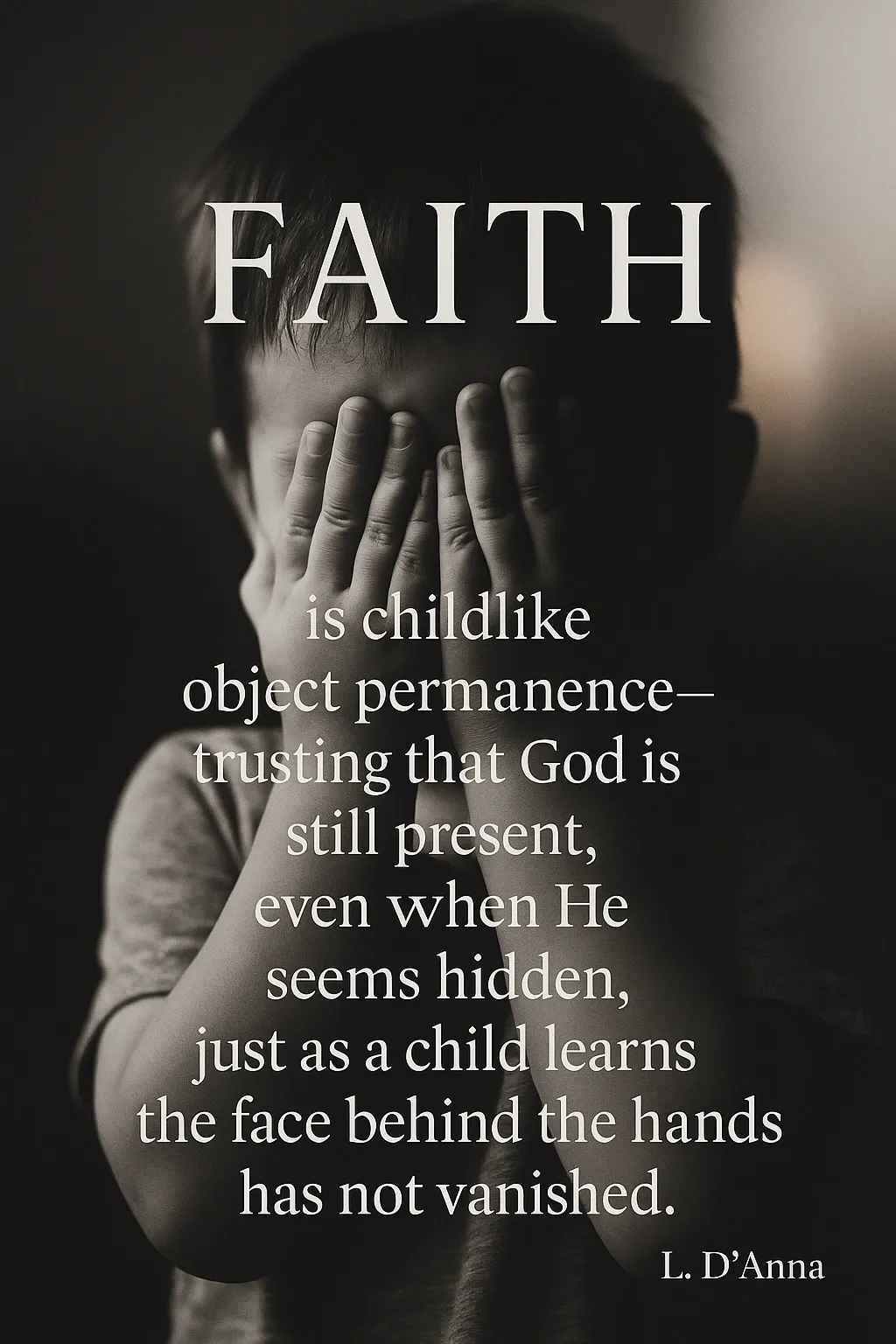
If you are a mom, you know that if you leave a room for just ten seconds, a baby will likely start crying when it feels your lack of presence. To the baby, you haven't stepped out; you have ceased to exist. It is not overreaction; it is psychology. Children have not yet developed what researchers call object permanence at this age, the understanding that people and things continue to exist even when they are out of sight.
Jean Piaget, the Swiss psychologist who mapped out stages of cognitive development, described object permanence as one of the first significant milestones of the infant mind. Around eight months old, a baby begins to grasp that the ball under the blanket is still there, that Mom hasn't vanished just because she's in the kitchen. This discovery is the beginning of trust, stability, and a world that does not collapse every time something disappears.
Faith works similarly. There are seasons when God feels hidden—when prayers echo back in silence or circumstances stretch out with no clear answer. Our first instinct, like that of a baby without object permanence, is to assume absence. If I cannot see God, perhaps He is gone. If I do not feel His nearness, maybe He has withdrawn.
But spiritual maturity is learning what babies eventually discover: unseen does not mean absent. Faith permanence is the soul's version of object permanence. It is the ability to hold steady when we cannot see or feel God, trusting that His presence is not erased by silence.
Object permanence strengthens the developing brain, and faith permanence strengthens the developing spirit—one anchors our understanding of reality, and the other anchors our trust in God.
So when life feels like an endless game of peek-a-boo with heaven, remember this: the hidden face has not vanished. Just as the child eventually learns to laugh when Mom comes back into view, faith learns to rest even when God is behind the veil.