By the time a person hits adolescence—around age 12 and up—their thinking leaps. They enter what Piaget called the formal operational stage. This is when abstract reasoning kicks in. Teenagers start to think about possibilities, not just facts. They can weigh hypotheticals, understand symbols, question assumptions, and imagine futures that don't exist.
This shift changes how they think about math or science and experience faith.
What Are Formal Operations?
Formal operations allow someone to:
- Think abstractly
- Handle complex reasoning
- Question and test ideas
- See multiple perspectives
- Imagine unseen realities
Before this stage, kids are grounded in the concrete: "God loves me because the Bible says so." Now they start asking deeper, sometimes uncomfortable questions:
- What if the Bible contradicts itself?
- What does "God is love" mean if people suffer?
- How do I know any of this is real?
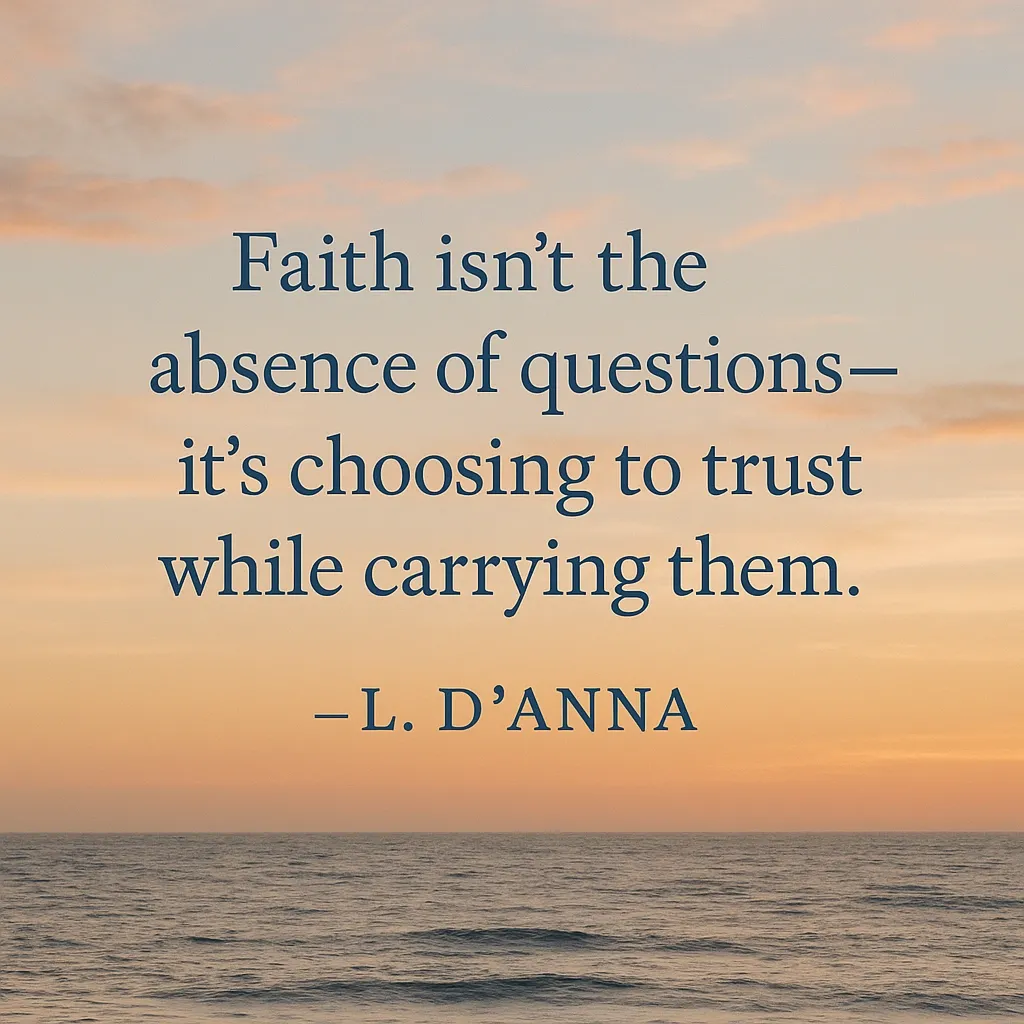
These aren't signs of doubt in the negative sense—they're signs of growth.
Formal operational thinkers are ready to build a more personal, resilient, and reflective faith.
Wrestling and Rebuilding
Whereas before, in the early stages of faith, their own is borrowed or passed down by parents, teachers, or a community. But during adolescence, that hand-me-down faith gets put to the test.
Formal operations make it possible to:
- Reflect on beliefs and why you hold them
- Tolerate ambiguity and paradox
- Hold space for mystery
- Develop personal convictions instead of just adopting inherited ones
This is often the stage when someone either makes faith their own—or walks away from it entirely, usually because it wasn't allowed to grow with them. They get a bit of doubt and don't investigate the doubt with deeper questions.
Doubt Is Not the Enemy
One of the biggest misconceptions about faith in the formal operations stage is that doubt equals failure. But doubt, when engaged honestly, is a tool. It forces deeper thinking, exposes shallow answers, and creates room for transformation.
The Bible contains people who wrestled with God: Job, David, and Jeremiah. Their faith wasn't neat. It was complex, raw, and genuine. That's precisely the kind of faith formal operational thinkers begin to explore—one that's strong enough to carry questions, not just answers.
Some verses in Scripture invite not blind acceptance but higher-order reasoning. Take Isaiah 45:7: “I form the light and create darkness; I make peace and create (RA-Evil) calamity; I, the Lord, do all these things.” To a literal reader, this seems troubling—how could a loving God “create evil”? But a deeper, more abstract analysis asks not only what the verse says, but what worldview and moral framework shape its meaning.
In Hebrew, the word translated as “evil” is ra—a term that means adversity, calamity, or consequence, not moral depravity. The verse speaks not of God manufacturing wickedness but of Him permitting a world where freedom has real consequence. God, being perfect love, created all beings—including those capable of choice. Even Satan was created as a radiant being of light; his rebellion was not authored by God but born from the misuse of that same divine gift: bechirah chofshit, free will.
This introduces a profound paradox that only abstract reasoning can hold: God remains the ultimate source of creation, yet not the source of corruption. The possibility of evil is the necessary shadow cast by genuine freedom. If choice is to be real, rejection must be possible. Light gains meaning only in contrast to darkness; goodness only when evil can be refused.
The Hebrew prophets never imagined life as a playground for comfort but as a school for the soul—a moral system designed for growth through tension and refinement through consequence. Divine love, in this view, does not prevent suffering; it transforms it. God’s love is not sentimental but sovereign. Evil is not proof of His absence but evidence of a moral structure in which turning from His light produces its own shadow.
Formal reasoning reveals that creation, free will, and moral consequence are not contradictions but components of one unified framework—a cosmos where perfect love allows freedom, and freedom makes both virtue and rebellion possible.
Faith as a Framework, Not a Formula
Adolescents and adults in the formal stage seek coherence—not just rules but a worldview that makes sense of life's messiness.
They start to recognize that:
- Faith isn't about control—it's about trust.
- Belief isn't binary—you can believe while still questioning.
- Spiritual maturity includes humility, nuance, and mystery.
This opens the door to theology, philosophy, ethics, and deeper spiritual practices. It's where faith stops being just about behavior and becomes about meaning.
How to Nurture Faith in This Stage
If you're mentoring, parenting, or pastoring someone in this stage, here's what helps:
- Don't shut down questions. Lean into them. Say "I don't know" if you don't.
- Offer frameworks, not just answers. Teach how to think, not just what to think.
- Encourage exploration. Reading, journaling, prayer, discussion, doubt—it all matters.
- Stay present. The journey is often bumpy, but being with someone during their questioning issues is more valuable than having all the correct answers.
Bottom Line
Faith in the formal operational stage isn't about certainty. It's about integration—weaving together belief, experience, doubt, and hope into something durable. It shifts from "I believe because I was told to" to "I believe because I've thought it through, questioned it, and still find it true."
That kind of faith doesn't break when the world gets hard.
It bends.
It wrestles.
And it holds.
 View the book ↗